A First Visit to a Coastal Derby: What to Notice Beyond the Score
A first visit to a coastal derby reveals more than the score: notice local symbols, shared matchday routines and the small signs that set a rivalry’s tone.
A first visit to a coastal derby can tell you more than the scoreline if you watch how the two towns share the matchday. Start with the signs, colours and small routines that appear around the ground; together, they show what the rivalry means to people who live with it all season.
You do not need to know every chant or old result. Treat the afternoon like reading a noticeboard: one symbol may mean little on its own, but the pattern around it can make the local story clearer. These field notes are for observing, not for copying anyone’s behaviour or seeking out a particular place.
Read the colours as local shorthand
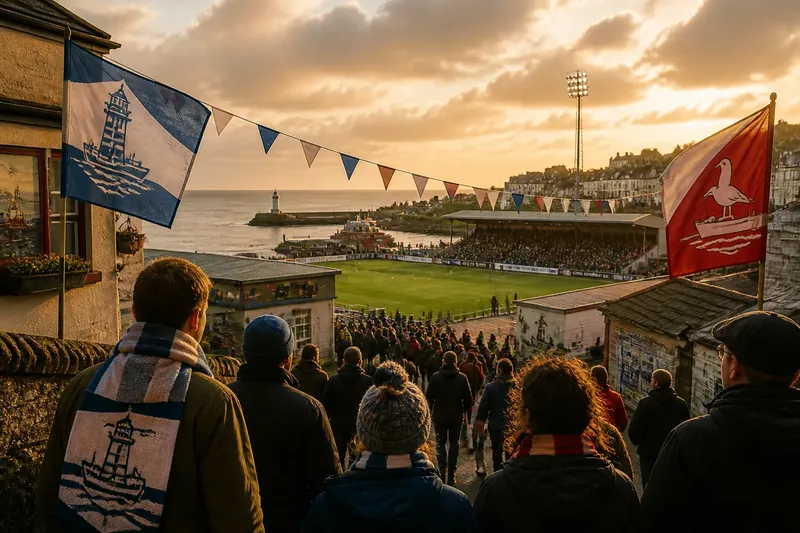
Club colours are the obvious starting point, but look for how they are worn and where they turn up. A scarf over a coat, a painted window, a badge on a fishing jacket or a strip of bunting across a shopfront may all connect football identity to ordinary life. Notice which details seem specific to the town rather than standard club merchandise.
Coastal clubs often have several kinds of local shorthand. A crest may include a ship, a lighthouse, a harbour shape or a bird associated with the shoreline. Such imagery does not automatically explain the rivalry, but it can show which parts of local identity supporters choose to carry into the ground.
Look, too, for colours used in contrast. If a derby programme, banner or street display places the two clubs side by side, pay attention to whether the presentation feels playful, proud or pointed. The same visual contrast can carry different weight in different settings, so treat it as a clue rather than a verdict.
Notice what both sides share
A derby is not only a contest between separate groups. It can also reveal a shared local calendar, familiar streets and routines that both sets of supporters recognise. You might see people greeting one another before they split towards different turnstiles, or hear a phrase that is understood on both sides even when it is used with different emphasis.
Shared habits can be quieter than chants. Watch for a familiar pause before kick-off, a wave towards a particular stand, or the way people respond when the teams emerge. These rituals may belong to one club, both clubs or the wider town; the point is to notice who joins in and how the moment changes as it passes through the crowd.
Listen for references that do not need explaining among regulars. A short song, a place-name, or a teasing line can act like a local password. If you do not recognise the reference, there is no need to force an interpretation. Take note of its timing: a chant aimed at a rival, a song for the home team and a tune shared across the ground signal different kinds of attachment.
Watch how the rivalry changes with the match
The atmosphere is rarely one fixed mood. It may begin with wry humour, tighten when a challenge draws a reaction, then soften when play pauses. Notice whether the crowd’s attention stays on the pitch or shifts towards the opposing end, and whether a burst of noise is answered, ignored or turned into laughter.
Small moments can say more than a loud exchange. A home crowd may applaud a visiting player who stops to help an opponent, or both ends may react to an unexpected goal with the same startled silence. Those responses do not erase the rivalry; they show which parts of football feeling are shared even on a charged afternoon.
Keep your eye on the gap between the players’ contest and the supporters’ commentary. A sharp chant can sound fierce while the people singing it remain relaxed; a low murmur can carry more tension than a long song. Tone comes from context, repetition and reaction, not merely from the words.
What should a first-time visitor listen and look for?
Which local symbols are worth noticing?
Look for repeated images on scarves, badges, banners and public-facing club displays. A symbol that appears in several settings is more likely to be part of local identity than a single decorative detail.
How can I tell whether a chant is playful or hostile?
Notice the delivery and the response around it: laughter, relaxed conversation or a brief answer may suggest banter, while a change in crowd attention can signal greater tension. You do not need to join in to understand that the tone has shifted.
What does a shared routine reveal?
A routine followed by both groups can point to a common matchday culture, even when each side gives it a different meaning. Watch who takes part and whether the moment is directed at the pitch, the club or the wider crowd.
Should I try to interpret every local reference?
No. Some references depend on local knowledge that may not be visible to a newcomer, and guessing can flatten a more complicated story. Keep the detail in mind and let repeated patterns speak for themselves.
Keep a few field notes in mind
A simple observation plan helps you stay attentive without turning the match into a hunt for clues. Choose a few details and follow them across the afternoon:
- Colours: note where club colours appear beyond shirts, and whether both sides use them in similar ways.
- Symbols: watch for repeated coastal or town imagery on flags, badges and ground displays.
- Routines: notice a repeated gesture, song or pause, and who seems to recognise it.
- Language: listen for place-names and local phrases, without assuming you know their full history.
- Changes in tone: compare the crowd before kick-off, during a tense passage and after a notable moment.
- Shared reactions: watch for occasions when both ends respond together, whether with laughter, surprise or applause.
Say you arrive knowing only the club names and colours. You notice a harbour emblem on a banner, hear a short chant repeated before kick-off, and later see both ends applaud a player who helps an opponent. You can record those observations without deciding that they explain the whole rivalry. The useful result is a more grounded sense of what the crowd shares and where its loyalties diverge.
Let the matchday setting add context
The ground’s setting can shape what you notice without becoming the subject of every moment. A view of the water, a wind coming off the shore or the sound of a nearby promenade may sit alongside the familiar football cues. Keep these details in the background and ask how supporters respond to them: do they become part of a song, a joke, a banner or simply the texture of the afternoon?
After the final whistle, the crowd’s dispersal can offer one last observation. Some people may leave in mixed groups, while others continue the rivalry in conversation or song. Watch the shift rather than trying to classify everyone. A derby’s tone is made up of many small exchanges, and no single gesture speaks for an entire town.
For a first visit to a coastal derby, the most useful question is not only who won, but what the crowd chose to repeat: a symbol, a routine, a local phrase or a moment of unexpected respect. Carry those details away alongside the score, and the next meeting between the clubs will feel less like an isolated fixture and more like part of a place’s continuing conversation.