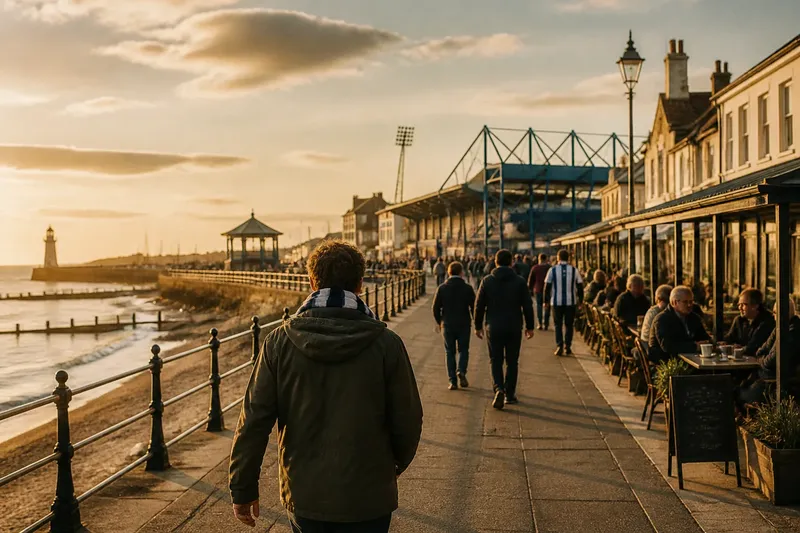
The Holiday-Town Club Myth: Why Coastal Support Runs Deeper
Coastal club support is not just a summer habit: see how work, family, routine and local belonging keep football rooted through the quieter months.

Coastal club support is not just a summer habit. A packed holiday-weekend terrace can make a seaside team look like an attraction for visitors, but the deeper story is often built on familiar faces, local routines and ties that hold through winter as well as sunshine.
Tourism can shape a club’s crowd and atmosphere. It does not explain every scarf, every season ticket or every argument about the team over Sunday lunch. These five strands help show why a coastal club can belong to its town all year.
1. Local work gives football a place in the weekly rhythm
A holiday town is still a place where people earn a living. Hospitality, fishing, transport, shops, schools and public services all have their own working rhythms, and those rhythms shape when supporters can gather. A match may be a rare shared afternoon for people whose shifts rarely line up.
That connection need not be romantic. Someone finishing a morning shift at a café may meet a relative at the ground; a shop worker may listen to the away commentary on the journey home. The club becomes part of an ordinary week, not an extra attraction reserved for visitors.
Seasonal employment can complicate attendance. People working through the busiest visitor months may have less time for a summer fixture, while quieter periods can make a regular Saturday easier to protect. The calendar does not divide neatly into “tourist season” and “football season”; residents negotiate both at once.
Imagine a harbour worker whose weekend rota changes with the weather and local trade. They cannot attend every home match, but they keep in touch through a family group chat and meet a friend at the ground when their shifts overlap. Their support is intermittent in person, yet firmly woven into local life.
2. Family ties carry the club beyond a single generation
Football allegiance often travels through small domestic rituals. A grandparent might keep an old programme in a drawer, a parent might explain why a certain fixture matters, and a child might learn the club’s colours before knowing the names of the players. None of this depends on a sunny day by the sea.
In coastal towns, families may also be spread across nearby villages or farther inland. A match can provide a reason to return, a familiar meeting point for relatives, or a subject that keeps conversation going between visits. The club’s reach may extend beyond the town boundary without becoming less local.
That inheritance is not automatic. Children may choose another team, and relatives may disagree. But shared memories give the club a place in family life even when attendance varies. A faded scarf can work like a recipe card: it carries a story, not merely a claim of ownership.
For clubs, this helps explain why a visitor-heavy crowd does not tell the whole story. A local supporter may miss a fixture and still pass on the habit of following the team. The bond can persist in conversations, keepsakes and family loyalties between matchdays.
3. The town’s geography shapes who feels close to the club
Coastal towns are not only beaches and promenades. Housing may stretch from a seafront centre to estates on a hill, a harbour district, a neighbouring village or a road that becomes awkward in poor weather. The ground’s location affects which communities can reach it easily and which must plan around buses, lifts or a long walk.
This matters because “local support” is not always confined to the postcode nearest the stadium. A club may draw regulars from settlements linked by schools, work, family or public transport. Some supporters live within sight of the water; others live well inland but still see the team as theirs.
Ground location can also influence routine. A stadium near the town centre may fit naturally around errands, while one on the edge can make the match a more deliberate outing. Neither arrangement makes support more authentic. They simply create different routes into the club.
Listen to how people describe those routes. One supporter may say they walk down from the estate; another may talk about catching the bus from a nearby village. These details reveal a wider local map than a postcard view of the seafront.
4. Familiar rituals survive changes in the tourist calendar
Support takes shape through repeated gestures: meeting at the same café, wearing a particular scarf, calling a relative after the final whistle or taking the same route to the ground. These habits can continue when visitors leave, the weather turns, or the team’s fortunes change.
Some rituals are visible at the stadium. Others happen at home, in a pub, at a workplace or in a message thread. A supporter who cannot attend may still follow team news with a neighbour or keep a matchday routine around the radio. The club’s social life is larger than the turnstiles.
That continuity is easy to overlook if attention falls only on peak-season crowds. A lively summer fixture can be genuine and enjoyable without representing the whole relationship between town and team. The quieter matchdays often show who has made following the club part of ordinary life.
These routines are not proof that every regular is lifelong, nor should they be treated as a test of belonging. They simply show how attachment can be renewed through repetition. Like a well-used path across a field, the route becomes familiar because people keep choosing it.
5. The club can serve as a shared local reference point
People in a coastal town do not all share the same work, background or view of the place. A football club can offer a common subject without erasing those differences. Supporters can argue about a substitution, remember a ground change or compare seasons, even if their everyday lives barely overlap.
The club’s role may be especially clear when people meet outside the stadium. A shopkeeper recognises a customer from the stand; a school conversation turns to the weekend result; someone returning to town asks how the team is getting on. Football gives residents a familiar thread to pick up again.
Visitors can join that conversation too. A holidaymaker who attends a match may become a welcome part of the crowd for an afternoon. The point is not to draw a hard line between locals and guests, but to avoid mistaking visitor presence for the whole source of a club’s identity.
For a coastal club, belonging can be layered: the matchday crowd includes people passing through, people who have moved away and people who live nearby year-round. Those connections can sit together. The seasonal audience adds colour, while local habits provide a longer-running frame.
What does year-round support look like?
Does tourism make a coastal club less local?
No. Visitors may add to a matchday crowd, but their presence does not cancel the club’s ties to residents, families and nearby communities. The useful question is how those different groups connect with the team across the calendar.
Can someone be a committed supporter if they miss matches?
Yes. Work, travel, caring responsibilities and transport can all affect attendance. Following the club through conversations, broadcasts or family routines can remain a meaningful part of someone’s life.
Why do quieter fixtures matter?
They can make everyday patterns easier to see, without the extra attention that a busy holiday period brings. Regular meeting places, familiar faces and return visits often tell more about a club’s local roots than crowd size alone.
Read the season as part of the town, not its whole story
To understand coastal club support, notice who returns when the promenade is quiet, who brings a child or relative, and how people fit the match around work and travel. These clues do not produce a single definition of local identity; they show the many ways it is maintained.
Coastal club support is deeper than a seasonal snapshot because it can be carried through ordinary routines, family memory and shared local conversation. The next time a summer crowd catches your eye, look again on a grey afternoon. The faces and numbers may change, but the town’s relationship with its club is still there.